Sunday, March 8, 2009

Charang-Kat

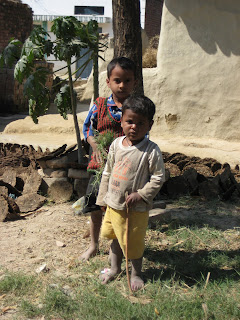
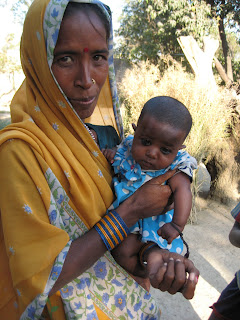
Down the hill from McLeodganj, the home of the Dalai Lama and the heart of the Tibetan refugee community is Lower Dharamsala. This community has fewer Tibetans; the larger 'refugee' community are the Ragistani who came because of drought and famine in the largely desert province of Ragistan. Many of these people came with no funds and no prospects and have settled in a slum project. Many of them have been beggars and rubbish pickers for generations, and have continued these occupations here, but with fewer resources than they had back in Ragistan. There are over 700 people (360 of them children) living in appalling circumstances. In 2004, 100% were illiterate and 98% of the children were malnourished. The average age span is 35 years. Most families have six to eight children, and the cycle of poverty keeps repeating. Things are beginning to change, but the problems are huge. Bound by caste and a belief in karma, there is an incredible sense of hopelessness in this community.

A local monk, Lobsang Jamyang, noticed some of the children gathering rubbish and eating the scraps from the window in his monestary. He was moved to start Tong-Len, a non-profit organization, in 2004 to provide some food and clothing, and since then has expanded the projects to try to begin to address some of the root causes of these problems through education, health, and social awareness programs, alcohol and domestic violence programs. Some micro-finance opportunities for other employment may be in the future particularly targeted toward the adolescent children who are still illiterate and at risk of simply marrying at 13 or14 and starting the cycle all over again.

Most of the children still show significant signs of malnourishment. Their hair, which should be dark and shiny has the reddish cast of protein malnutrition and a 2 year old child may weigh as little as 2.2 kilograms (about 5 pounds). Obviously the long term impacts on not only health, but also cognition are huge. Most have not been vaccinated, and disease spreads easily through the slum as there are no good sanitation facilities. The project is forbidden from building any good sanitation as these folks are squatters on the land.

Jamyang has learned over time that intervention is slow and requires shifting cultural practices and beliefs. He also understands that he can't simply provide resources, because those resources often don't go where they are needed. For example, when they first started distributing vitamins and some food items, they found that some families were selling them to get money for alcohol. Now the project manager monitors more closely to assure that the target populations, the children and pregnant and lactating mothers, are actually getting the vitamins and food. If not, then that family is cut out of the program for awhile to learn the lesson.

They have opened a small school in the slum site (a blackboard and a cement floor under a tarp) where some of the children can learn about what 'school behavior' is in preparation to possibly go on to get some education. Forty of the children from the slums are now in boarding school just up the road. Jamyang involves these children in developing community education programs (through performance, song, dance) about issues like immunizations, sanitation, and nutrition. He is trying to instill in these children a sense of responsibility back to their own community and to use their connections with their families and relatives to bring better information and some hope. These children are the living proof to the community that education may actually result in a better life for their children, something none of them believed in 2004. Jamyang had trouble persuading families to send a child to school then, but now they are lining up for the few spots available.

The global economic crisis means that even the traditional sources of income for these people, begging on the streets or shining shoes, which are both dependent on the tourist industry, are diminished because fewer tourists are coming. Even rubbish collecting does not bring in as much. The metals and plastics they could sell for 32 rupees per kilo last year are now only bringing 32 rupees.

This visit was the first time that most of the students have seen this level of poverty and hopelessness face to face and the impact was very powerful. For me too.

M

Saturday, March 7, 2009

Tibetan Soup


After the rich foods of the plains of India (everything is cooked in ghee and paneer, a cheese that has the texture of tofu is one of the main sources of protein), it is refreshing to find that Tibetans eat a lot of Ghantauk, a wonderful soup made with very fresh vegetables and noodles. I searched out a cooking class here and spent a wonderful afternoon learning how to cook three different kinds of soup with varied noodles, including a little stuffed dumpling (sort of like a potsticker) called a Momo. Just like in Thailand and India, wonderful food is put together in tiny little kitchens with a single burner and a wok.
Sangye, who taught me, had most of the vegetables prepared (chopped fresh boy choy, spinich, red onions, ginger, garlic, tomato, a little green pepper, and we spent most of our time learning to make the varied noodle shapes that give each soup its name. While we cooked, he told me the story of his escape from Tibet (Ahimsa post), then we shared soup together. Both my belly and my heart were full.

Thursday, March 5, 2009

Ahimsa and stories of courage

Dharmasala has brought me to tears every day I have been here. Almost each person I meet tells another story of incredible courage and bravery about escaping the repression in Tibet.

Sangye (23) and his 19 year old buddy, simply left their village in Western Tibet, took a bus to Lhasa and then pretended to be 'businessmen' buying nomad artifacts so that they could get near enough to the Nepal border to risk the crossing over a pass near Mt Everest. Today he taught me how to cook Tibetan soups and as we rolled noodles together he told me a tale that if I saw it in a Hollywood film I wouldn't believe. They were surrounded by Chinese soldiers with guns and escaped through the wiles of a clever monk, they stumbled into one of the only safe homes near the border where the owner has a secret room dedicated to the Dalai Lama. (It is against the law and punishable by prison to even have his picture in your home in Tibet.) He was able to give them some directions that helped point them toward the right pass. They almost froze to death on the mountain passed, bluffed group of Chinese soliders with their businessman story when they were stopped for an identity check. After crossing the border into Nepal, frozen and starving and still in danger of being captured by Nepali police and sent back, they happened on two traders with yaks who formerly had traded with Tibet and sheltered and fed them. This retelling doesn't even capture the amazing events. Sangye said, "I don't know if we were stupid or brave, but we had to leave because we couldn't get an education, we couldn't speak about our beliefs or practice our religion and we wanted to see the Dalai Lama."

Kelsang at 23 walked out of Tibet into Nepal with her 11 year old brother. Her mother had died (and her brother, returning from India to see his dying mother had been put in prison). She left a career as a nurse, which she said was a good job, but distressing because she witnessed discriminatory treatment of Tibetan and Chinese patients in the hospital.

Every single refugee I have talked to says that, whatever else motivated them to leave, they have come to see the Dalai Lama. His power move people to risk their lives and leave everything behind - family, friends, work - to come to a country where they have no passport, no chance for employment, but do have the chance to be fully Buddhist, is astonishing.

The commitment of the Tibetan people to ahimsa, to non-violence and compassion, is also moving, especially in the face of the kinds of discrimination and repression they have faced in Tibet. Today we listened to a former monk who was imprisioned and tortured for over four months in Tibet because he raised his voice in protest about the restrictions on religion. After he was finally released, he happened to meet two of the guards who had tortured him on the streets of Lhasa. He actually greeted them and invited them to have tea with him. He lives the value of compassion, even for those who have harmed him, in the very core of his being, but I also heard similar stories and the reiteration of the commitment to non-violence and compassion for the Chinese people from every refugee I have talked with, although many speak of the Chinese government as cruel.
These stories are humbling; terrifying and courageous, heartbreakingly sad and breathtakingly inspirational. They are stories full of love - love for faith (and the man who symbolizes it), love for country and culture, and a love for the human spirit that refuses to be broken.
I'll end this post with a quote from Arundhati Roy that my friend Molly sent me yesterday. It seems appropriate.

"To love, to be loved
to never forget your own insignificance
to never get used to the unspeakable violence and the vulgar disparity of life around you

To seek joy in the saddest places
to pursue beauty to its layer
to never simplify what is complicated
to complicate what is simple

To respect strength, never power
above all, to watch, to try to understand
to never look away
and never forget."

M

Youngling Creche & Kindergarten


Today we volunteered at one of the schools in Dharamsala that teaches the children of the Tibetan refugees here. One of the major goals of the Dalai Lama, and one that is passionately supported by the refugees, is the preservation of the unique culture and language of Tibet, especially they are being systematically eradicated in Chinese occupied Tibet. In the early days of exile, many parents withdrew their children from school to earn some extra money at any odd job. The government in exile and the Dalai Lama stressed the importance of education and a number of both private and government run schools open. Youngling is a nursery school and kindergarten, serving kids from 18 months to 5 years while their parents work or go to school to learn skills.


The children are, of course, darling. We watched the day begin with morning prayers, mostly done as the children (not the babies, but the 2-5 year olds, stood in lines and sang back each line the teacher sang. Those kids stood there for well over 20 minutes, keeping in their straight lines in call and response. Add Image


It seems that most of the instruction is done in this recitation style. After the prayers, we observed/helped in the four year old room, and the next day in the Kindergarten. The teaching style reminds me of the methodology they called Direct Instruction in the US. (Although there was no teacher guide to follow). The four year old children were learning the Tibetan alphabet and numbers and the English words for the days of the week. The teacher said a word and the children, sitting in little two person desks, called back the answers. The five year olds were learning three letter words with the 'a' sound in the middle (like bat, cat, jam). Again the teacher called out the phonetic sounds and the word and the children (at the top of their lungs) shout back. Although there was some squirming, obviously the expectation is that the children will sit quietly and pay attention for significantly long periods of time. This whole observation was a striking difference than most preschools I have seen in the United State. Songs and rhymes are obviously an important vehicle for instruction. For the days of the week and for the Tibetan alphabet, after the teacher modeled verbally, there was also a song that incorporated what she was trying to teach.


Teaching Tibetan culture is central to this school's mission, and the music teacher came to teach the four year olds a traditional Tibetan song. I couldn't get a translation from the teacher, but she said that it was a kind of marching or walking song. They also learn traditional Tibetan dance. On Monday I will visit one of the government run schools, the Tibetan Children's Day School.


Tuesday, March 3, 2009

Dharamsala


Monday we wended our way out of the Ganges plain, up through the clouds of smog, into the Himalyan mountains. We're now in McLeodganj, the upper village of Dharamsala where the Dalai Lami and thousands of Tibetan refugees live, a set of twisted and turning streets, all the buildings hanging off the edge of hillsides at 7000 feet above sea-level. This hillside village is a complex place with a history as twisted as its streets. The Dalai Lama escaped from Tibet in 1959 and was given refuge in this place, where he has lived for the past 50 years as he struggles for Tibetan automony and to sustain the Tibetan culture and practices in this community. The Tibetans have lived in relative harmony with the local hilltribes who were displaced themselves by the thousands of immigrants who still pour across the border. Although the Indian government offered the Tibetans asylum here, as often goes with large central governments, the local tribal people were not consulted. However, a large economy of tourism related to the Tibetan cause and to the practices and teachings of Buddhism has arisen here that supports both the local people and the Tibetans in exile.

We will be in this community for the next two weeks, volunteering at some local schools which are organized to combine the teaching of modern education with the teaching of Tibetan language and culture. We also have the opportunity to work with adult refugees to help them learn English and to hear their stories of escape from Tibet.

The climate here reminds me of late spring in the NW. Cool in the mornings and warmer after noon. Evenings are quite chilly. It's a relief to be out of the heat of the Ganges plain and into air that is cleaner, washed by the winds that pour down over the mountains each night.

The evidence of the presence of the Dalai Lama and Buddhist faith is everywhere. His picture, draped with white banners, is in every establishment, prayer flags fly over the homes and are strung down the hillsides, stupas with prayer wheels are found along the main streets, and most pedestrians stop by to spin the wheels as they walk to have a cup of chai or to meet a friend or to catch the bus.

The month of March marks important historical events for the Tibetan people, and this year is a particularly poignant time. Tuesday, March 10, is a very bittersweet day in Dharamsala. It is the 50th anniversary of Tibetan Uprising Day when the Tibetans orginally arose to protest the Chinese occupation of Tibet. The Dalai Lama left Tibet on March 14, 1959, finally arriving in India on March 31st. We have been told that there will be many events to mark this 50th anniversary, many of them questioning the viability of the Dalai Lama's adherence to the middle path all these years. Even the Dalai Lama himself seems to be moving away from this idea as the last of 8 rounds of talks with China have failed to make any progress for either Tibetan autonomy or for better conditions for those Tibetans still living in Tibet.

Saturday, February 28, 2009

India-Pakistan Border


Yesterday we went to witness one of the more bizarre political/social events I have ever seen. Every day, when the border between Pakistan and India is closed for the night, there is a competition between India and Pakistan for who can round up the most spectators and put on the biggest show. There are actually concrete bleacher built on both sides to seat the crowds who come. These pictures are all from the India side of the border, but although there were fewer people on the Pakistani side, the uniforms were equally as splendid and the roars from the crowd as loud. The whole event was a blend of calls of nationalistic pride, a mosh pit rave and the changing the guard at Buckingham Palace. There were crowd pleasing chants reminiscent of the cheerleading at football games, with one man on India's side leading "Long live Hindustan" while the other side tried to drown the crowd out by shouting "Long live Pakistan. Women and children were invited from the crowd to carry flags to the border and back (interesting that no men were allowed. This is the first time I have seen women given a privileged spot, and I wonder if it is because there is concern about what testosterone might spark if the men come face to face across the border. Then the music began to blare and the women and children began to dance in the street that leads to the border, almost a mosh pit rave. Finally the guards themselves came out to close the border, the Indian and Pakistani guards in an obviously choreographed display of fierceness, with very showy marching, music, high stepping and a ceremony that brought the two flags down exactly at the same time. Then the gates were closed for the night, and the truckers lined up on either side of the border settled down to drink chai, gossip with each other and sleep in their cabs until the border opens again in the morning. It's hard to believe that this circus happens every day with hundreds of people showing up on both sides, but we're told it does. Perhaps this event diffuses some of the tensions that this region has been steeped in since the partition in the 1940s. Can you imagine an event like this at the US/Canadian border?

Hunger in India


Yesterday's Time of India published finding from a report by the United Nations World Food Programme about hunger in India. This report portrays in facts and figures the reality that we have seen starkly portrayed during our travels. According to the report, 230 million people in India are chronically undernourished and malnutrition accounts for nearly 50% of child deaths in India and 30% of adults have a BMI of less that 18.5. Most of the children we worked with in Sarnath were very small for their ages. Pre-natal malnutrion results in babies who are very tiny and small boned and the report says that every second child in India is stunted in growth. Macail would tower over many of the 5 and 6 year olds, and the women are very tiny, their arms so thin that the bangles they wear for marriage do not fit over our large Western hands. More than 70% of children under 5 suffer from anemia, and according to this report, the levels of anemia are actually rising with 11 of the 19 states in India having more than 80% of children with anemia.


As we left Uttar Pradesh and moved in to the Punjab region, the differences between those who can eat and those who do not have enough food became even clearer. Punjab is the bread basket of India, producing nearly 70% of the food supply, and the relative wealth is evident. Many more of the population appear well fed, the men are significantly taller and sturdier than in the other parts of India we have visited and I actually saw my first obese Indian woman yesterday at the temple.
Rising food prices world wide and corruption and inefficiency in the "Targeted Public Distribution System" for food supplies, have, according to the Time "lead to greater food insecurity for large sections of the poor and near poor."